Thursday, November 13, 2014

Al Jubail Petrochemical Company Al-Mojil Group Grain Silos and Flour Mill Organization Ministry of Municipal and Rural Affairs Ministry of Water and Power National Contracting Company Royal Comissions of Jubail and Yanbu Saudi Arabian Fertilizer Company Saudi Arabian Oil Company – Saudi ARAMCO Saudi Basic Industries Corporation Saudi Iron and Steel Company - Hadeed Saudi Yanbu Petrochemical Company Saudi Kayan Petrochemical Company

Kettaneh construction Saudi Arabia QA/QC

Kettaneh Construction is fully dedicated to Quality, Safety and Environment

Kettaneh Construction Quality Management System ISO 9001:2000 is certified under Bureau Veritas and applies to each of its operating companies.


Kettaneh Construction is fully dedicated to Health, Safety and Environment
Kettaneh Construction is currently applying for OHSAS 18001 for Health & Safety, along with ISO 14001 for Environment.

Kettaneh Construction Saudi Arabia Ltd group philosaphy

Since its incorporation, the Kettaneh Construction Group has adopted a working philosophy which allowed it to dynamically evolve through the years taking into consideration the ever increasing challenges within the industry, market places and more specifically its clientele requirements in terms of Budget, Quality and Time frames.

To that extent, its continued success stems from a number of factors that have always been the pillars of the group work philosophy.


Transparent and trust based relations with clients aimed at building long term partnership in a win-win frame work.
Meeting or exceeding client expectations in terms of all project deliverables, through a proactive approach aimed at adding value to their needs and requirements and providing them with the highest construction standards
Nourishing the capabilities, technical know how and managerial skills of human capital to meet the increasingly complex requirements of the construction projects.
Continually improving delivery process to meet the best industry practices.
Strengthening project control processes and assuring timely response to concern issues that might arise during the delivery process.
Building a strong and diversified network of suppliers and service providers in all operating regions, as well as many international vendors.
Investing in infrastructure enablers including most up to date industry software planning and scheduling solutions, ERP solutions, document management systems and many others.
Continuously nourishing a vibrant organization characterized by strongly held corporate values and quality culture as well as dynamic, scalable and delivery oriented structure.
Properly managing a pool of financial resources handled by a team of valued professionals who earned the trust and support of major banks and have always proven their capabilities in securing the required project funds

Successful Interview Tips

Why Do Candidates Fail In An Interview

  • Poor grooming
  • Discourteous and ungraceful body language
  • Poor manners
  • Poor diction
  • Vague responses
  • Unappealing resume
  • Monetary benefits-centric approach
  • Lack of punctuality
  • Poor waiting hall behavior
  •  
Some Behavioural "Unfavourable" Aspect
  

  • Lack of personal or career goals
  • Lack of enthusiasm and confidence
  • Not owning up responsibility for mistakes
  • Self-justification, aggressiveness
  • Lack ofemotional maturity
  • Negative and cynical attitude
  • Over-reacting to questions
  • Lacking sense of humour
  • Complaining about various things and previous employers 
  •  
Preparing for an interview - Look for
  • Company's main products and services and likely new products and services
  • Its key markets, its position in market and between major competitors
  • Its financial position / profit / turnover
  • Its history, reputation and achievements
  • Arrange all the papers required in a folder : Resume / CV, call letters, degree certificates, mark lists, NSS, NCC, sports / games certificates, experience certificates, references.
The Previous Day
  • Confirm the venue of the interview, distance, and mode of transport
  • Locate the venue earlier
  • Relax, have good sleep, visualise and pray
The Interview Day
  • Reach the venue at least 45 minutes ahead of the interview
  • Get familiar with the amblience
  • Dont carry too much baggage
  • Report to the authority concerned
Waiting Hall Behaviour
  • Maintain Decorum
  • Mingle with others politely
  • Avoid smoking, chewing, flirting, gossiping, defamatory comments
  • Greet others present
  • Switch off the mobile
  • Relax and visualise
While Entering The Interview Hall
  • Enter confidently, not arrogantly
  • Shut the door gently
  • Smile and greet the interviewers
  • Shake hands only if they offer their hand
During The Eye Interview
  • Maintain eye contact
  • Be attentive, listen carefully, and lean forward
  • Don't lean on the table, and don't slouch
  • Don't toss your files across
  • Hand over your file-right side facing them
  • Don't laugh or giggle but smile gently
  • Be polite. use the words "Please" and "thank you"
  • Don't argue but can orally acknowledge
 

List of Important Government Web sites

Ministry of Overseas Indian Affairs http://moia.gov.in
Department of Biotechnology http://dbtindia.nic.in
Bureau of Indian Standards http:// www.bis.org.in
Department of Chemicals & Petrochemicals http://chemicals.nic.in
Ministry of Civil Aviation http://civilaviation.nic.in
Department of Commerce http://commerce.nic.in
Ministry of Coal http://coal.nic.in
Ministry of Company Affairs http://dca.nic.in
Department of Education http://education.nic.in
Ministry of Environment and Forests http://envfor.nic.in 


Department of Explosives http://explosives.nic.in
Ministry of External Affairs http://www.meanindia.nic.in
Ministry of Finance http://finmin.nic.in
Directorate General of Foreign Trade http://dgft.delhi.nic.in
Department of Heavy Industries http://dhi.nic.in
Department of Industrial Policy & Promotion http://dipp.nic.in
Ministry of Information and Broadcasting http://mib.nic.in
Department of Information Technology http://www.mit.gov.in
Ministry of Labour http://labour.nic.in
Ministry of Mines http://mines.nic.in
Ministry of Non-Conventional Energy Sources http://mnes.nic.in
Office of The Controller General Of Patents http://patentoffice.nic.in
Ministry of Petroleum And Natural Gas http://petroleum.nic.in
Ministry of Power http://powermin.nic.in
Ministry of Railways http://www.indianrailways.gov.in
Reserve Bank of India http://www.rbi.org.in
Department of Road Transport & Highways http://morth.nic.in
Department of Shipping http://shipping.nic.in
Ministry of Small Scale Industries http://ssi.nic.in
Ministry of Statistics and Programme Implementation http://mospi.nic.in
Department of Telecommunication http://www.dotindia.com
Ministry of Textile http://texmin.nic.in
Ministry of Tourism http://tourismofindia.com
Ministry of Urban Development http://urbanindia.nic.in
Ministry of Water Resource http://wrmin.nic.in

Website Addresses of States/Union Territories

Andaman & Nicobar (UT) http://andaman.nic.in
Andhra Pradesh http://www.aponline.gov.in
Assam http://assamgovt.nic.in
Bihar http://bihar.nic.in
Chandigarh(UT) http://chandigarh.nic.in
Chhattisgarh http://chattisgarh.nic.in
Dadra & Nagar Haveli http://odic.nic.in
Daman & Diu http://daman.nic.in
Delhi http://delhigovt.nic.in
Goa http://goagovt.nic.in
Gujarat http://www.gujratindia.com
Haryana http://haryana.nic.in
Himachal Pradesh http://himachal.nic.in
Jammu & Kashmir http://jammukashmir.nic.in 
Jharkhand http://jharkhand.nic.in
Karnataka http://www.karnataka.nic.in
Kerala http://www.kerala.gov.in
Lakshdweep(UT) http://lakshadweep.nic.in
Madhya Prdesh http://www.mp.nic.in
Maharashtra http://maharashtra.gov.in
Manipur http://manipur.nic.in
Meghalaya http://meghalaya.nic.in   
Mizoram http://mizoram.nic.in
Nagaland http://nagaland.nic.in
Orissa http://orissagov.nic.in
Pondicherry(UT) http://pondicherry.nic.in
Punjab http://punjabgovt.nic.in
Rajasthan http://www.rajasthan.gov.in
Tripura http://tripura.nic.in
Uttar Pradesh http://upgov.nic.in
Uttranchal http://gov.ua.nic.in
West Bengal http://www.wbgov.com
Sikkim http://sikkimgov.nic.in
Tamil Nadu http://www.tn.gov.in

Toll free Numbers in India

DescriptionNumber
Blood Bank 1910
Women in Distress 1020
CATS 1099
eye bank helpline 1919
Child Labour complaint Old age help line anti courreption Help Line 1098
Heart Attack 1050
Heart Brigade 1051
Police 100
Fire brigade 101
Accidents 102
AIDS Control Centre 1097
Local Assistance 199

Airlines Toll Free Phone Numbers :
Indian Airlines 1800 180 1407
Jet Airways 1800 22 5522
SpiceJet 1800 180 3333
Air India 1800 22 7722
KingFisher 1800 180 0101


Automobiles Toll Free Phone Numbers :
Mahindra Scorpio 1800 22 6006
Maruti 1800 111 515
Tata Motors 1800 22 5552
Windshield Experts 1800 11 3636


Banks Toll Free Phone Numbers :
ABN AMRO 1800 11 2224
Canara Bank 1800 44 6000
Citibank 1800 44 2265
Corporatin Bank 1800 443 555
Development Credit Bank 1800 22 5769
HDFC Bank 1800 227 227
ICICI Bank 1800 333 499
ICICI Bank NRI 1800 22 4848
IDBI Bank 1800 11 6999
Indian Bank 1800 425 1400
ING Vysya 1800 44 9900
Kotak Mahindra Bank 1800 22 6022
Lord Krishna Bank 1800 11 2300
Punjab National Bank 1800 122 222
State Bank of India 1800 44 1955
Syndicate Bank 1800 44 6655


Cell Phones Toll Free Phone Numbers :
BenQ 1800 22 08 08
Bird CellPhones 1800 11 7700
HTC 1800 11 33 77
Motorola MotoAssist 1800 11 1211
Nokia 3030 3838
Sony Ericsson 3901 1111


Computers/IT Toll Free Phone Numbers :
Adrenalin 1800 444 445
AMD 1800 425 6664
Apple Computers 1800 444 683
Canon 1800 333 366
Cisco Systems 1800 221 777
Compaq HP 1800 444 999
Data One Broadband 1800 424 1800
Dell 1800 444 026
Epson 1800 44 0011
eSys 3970 0011
Genesis Tally Academy 1800 444 888
HCL 1800 180 8080
IBM 1800 443 333
Lexmark 1800 22 4477
Marshal’s Point 1800 33 4488
Microsoft 1800 111 100
Microsoft Virus Update 1901 333 334
Seagate 1800 180 1104
Symantec 1800 44 5533
TVS Electronics 1800 444 566
WeP Peripherals 1800 44 6446
Wipro 1800 333 312
xerox 1800 180 1225
Zenith 1800 222 004


Couriers/Packers & Movers Toll Free Phone Numbers :
ABT Courier 1800 44 8585
AFL Wizz 1800 22 9696
Agarwal Packers & Movers 1800 11 4321
Associated Packers P Ltd 1800 21 4560
DHL 1800 111 345
FedEx 1800 22 6161
Goel Packers & Movers 1800 11 3456
UPS 1800 22 7171


Education Toll Free Phone Numbers :
Edu Plus 1800 444 000
Hindustan College 1800 33 4438
NCERT 1800 11 1265
Vellore Institute of Technology 1800 441 555
Amity University NCR Delhi 1800 110 000


Healthcare Toll Free Phone Numbers :
Best on Health 1800 11 8899
Dr Batras 1800 11 6767
GlaxoSmithKline 1800 22 8797
Johnson & Johnson 1800 22 8111
Kaya Skin Clinic 1800 22 5292
LifeCell 1800 44 5323
Manmar Technologies 1800 33 4420
Pfizer 1800 442 442
Roche Accu- Chek 1800 11 45 46
Rudraksha 1800 21 4708
Varilux Lenses 1800 44 8383
VLCC 1800 33 1262


Home Appliances Toll Free Phone Numbers :
Aiwa/Sony 1800 11 1188
Anchor Switches 1800 22 7979
Blue Star 1800 22 2200
Bose Audio 1800 11 2673
Bru Coffee Vending Machines 1800 44 7171
Daikin Air Conditioners 1800 444 222
DishTV 1800 12 3474
Faber Chimneys 1800 21 4595
Godrej 1800 22 5511
Grundfos Pumps 1800 33 4555
LG 1901 180 9999
Philips 1800 22 4422
Samsung 1800 113 444
Sanyo 1800 11 0101
Voltas 1800 33 4546
WorldSpace Satellite Radio 1800 44 5432


Hotel Reservations Toll Free Phone Numbers :
GRT Grand 1800 44 5500
InterContinental Hotels Group 1800 111 000
Marriott 1800 22 0044
Sarovar Park Plaza 1800 111 222
Taj Holidays 1800 111 825


Insurance Toll Free Phone Numbers :
AMP Sanmar 1800 44 2200
Aviva 1800 33 2244
Bajaj Allianz 1800 22 5858
Chola MS General Insurance 1800 44 5544
HDFC Standard Life 1800 227 227
LIC 1800 33 4433
Max New York Life 1800 33 5577
Royal Sundaram 1800 33 8899
SBI Life Insurance 1800 22 9090


Mattresses Toll Free Phone Numbers :
Kurl- on 1800 44 0404
Sleepwell 1800 11 2266


Investments/Finance Toll Free Phone Numbers :
CAMS 1800 44 2267
Chola Mutual Fund 1800 22 2300
Easy IPO’s 3030 5757
Fidelity Investments 1800 180 8000
Franklin Templeton Fund 1800 425 4255
J M Morgan Stanley 1800 22 0004
Kotak Mutual Fund 1800 222 626
LIC Housing Finance 1800 44 0005
SBI Mutual Fund 1800 22 3040
Sharekhan 1800 22 7500
Tata Mutual Fund 1800 22 0101


Paints Toll Free Phone Numbers :
Asian Paints Home Solutions 1800 22 5678
Berger Paints Home Decor 1800 33 8800


Teleshopping Toll Free Phone Numbers :
Asian Sky Shop 1800 22 1800
Jaipan Teleshoppe 1800 11 5225
Tele Brands 1800 11 8000
VMI Teleshopping 1800 447 777
WWS Teleshopping 1800 220 777


Travel Toll Free Phone Numbers :
Club Mahindra Holidays 1800 33 4539
Cox & Kings 1800 22 1235
God TV Tours 1800 442 777
Kerala Tourism 1800 444 747
Kumarakom Lake Resort 1800 44 5030
Raj Travels & Tours 1800 22 9900
Sita Tours 1800 111 911
SOTC Tours 1800 22 3344
Ticketvala .com 1800 209 2222


UPS :
APC 1800 44 4272
Numeric 1800 44 3266


Indian Railways :
Indian Railway General Enquiry Number 139
Indian Railway Central Enquiry Number 139
Indian Railway Reservation Enquiry Number 139


Others Important Helplines :
Consumer Helpline 1800 11 4000
loreal garnier 1800 223 000
KONE Elevator 1800 444 666
Indane 1800 44 51 15
Aavin 1800 44 3300
Pedigree 1800 11 2121
Kodak India 1800 22 8877
Domino’s Pizza 1800 111 123
World Vision India 1800 444 550
Telecom Monitoring Cell 1800 110 420

Kettaneh Construction Saudi Arabia Ltd

The Kettaneh brothers established their first business in Lebanon in the aftermath of World War I. Their activities started with the construction of roads and bridges. 

In the years that followed, the scope, the nature and the diversity of fields of work led to the development of a group of sister and affiliated companies with offices or branches in all major cities of the Middle East as well as in important international business centers.
Today, companies belonging to the Kettaneh Group are incorporated in many countries and cover quite a diversified range of activities, including notably: 

• Engineering & Contracting

• General Trading & Distribution 

The countries involved are Egypt, France, Iran, Iraq, Jordan, Lebanon, Luxembourg, Qatar, Saudi Arabia, United Arab Emirates, the United Kingdom and the United States of America.
Kettaneh companies carry out their activities in different styles. In many cases, they undertake the projects as Main Contractors with overall responsibility for the execution of the works on a turnkey basis, which may also include design.
They also operate as Subcontractors carrying out civil works and Electromechanical installations. For certain large projects, they  enter into consortia or joint ventures with other firms.

Rashtriya Swayamsevak Sangh in Indian independence movement

The RSS portrayed itself as a social movement and refused to consider itself a political party, and did not play any role in many of the efforts in Indian independence movement.[37] When the Congress passed the Purna Swaraj resolution in 1930, Hedgewar asked all the RSS branches to hoist the Indian flag and organize lectures on the need for independence.[38] However, the RSS emphatically rejected Gandhiji's willingness to cooperate with Muslims in the Anti-British struggle.[37] In 1934, Congress passed a resolution prohibiting its members from joining RSS, Hindu Mahasabha or Muslim League.[38]
Golwalkar did not want to give the British any excuse to ban the RSS.[39] When the British Government banned military drills and use of uniforms in non-official organizations, Golwalkar terminated the RSS military department.[39]

Activities during partition

The Partition of India affected millions of Sikhs, Hindus, and Muslims attempting to escape the violence and carnage that followed.[40] Noted Gandhian and recipient of the highest civilian award in India, Bharat Ratna, Bhagwan Das commended the role of the "high-spirited and self-sacrificing boys" of the RSS in protecting the newly formed Republic of India, from a planned coup to topple the Jawaharlal Nehru Administration in Delhi.[41][42]

First ban and the acquittal

Following Mahatma Gandhi's assassination in 1948 by a former member[17] of the RSS, Nathuram Godse, many prominent leaders of the RSS were arrested and RSS as an organisation was banned on 4 February 1948. A Commission of Inquiry into Conspiracy to murder of Gandhi was set and its report was published by India's Ministry of Home Affairs in the year 1970. Accordingly Justice Kapur Commission[43] noted that the "RSS as such were not responsible for the murder of Mahatma Gandhi, meaning thereby that one could not name the organisation as such as being responsible for that most diabolical crime, the murder of the apostle of peace. It has not been proved that they (the accused) were members of the RSS."[43]:165
RSS Leaders were acquitted of the conspiracy charge by the Supreme Court of India and following an intervention by the Court, the Indian Government agreed to lift the ban with condition that the RSS adopt a formal constitution. The second Sarsanghachalak, Golwalkar drafted the constitution for the RSS which he sent to the government in March 1949. In July of the same year, after many negotiations over the constitution and its acceptance, the ban on RSS was lifted.[20]
On 15 January 2000, The Statesman carried a story about the RSS that depicted the RSS as the killer of Gandhi.[44] Subsequently the Delhi unit of the RSS filed a criminal case of defamation against author of the article A. G. Noorani along with the cartoonist and the Managing Director of the publishing house. When two of the accused did not respond to the Court summons, non-bailable warrants were issued in their name by the Court.[45] On 25 February 2002, Noorani wrote an unconditional apology to the court in which he regretted writing the defamatory article against the RSS. On 3 March 2002, The Statesman also published an apology regretting the publication of the article.[46][47]

Decolonisation of Dadra, Nagar Haveli and Goa

After the independence of India, RSS was one of the socio-political organisations who supported and participated in movements to decolonise Dadra and Nagar Haveli, which was at the time ruled by Portuguese colonists. In early 1954, volunteers Raja Wakankar and Nana Kajrekar of the RSS visited the area round about Dadra and Nagar Haveli and Daman several times to study the topography and also to get acquainted with locals who wanted to switch from being a Portuguese colony to being an Indian union territory. In April 1954, the RSS formed a coalition with the National Movement Liberation Organization (NMLO), and the Azad Gomantak Dal (AGD) for the liberation of Dadra and Nagar Haveli.[48] On the night of 21 July, United front of Goans, a group, working independently of the coalition, captured the Portuguese police station at Dadra and declared Dadra as free. Subsequently on 28 July, volunteer teams of the RSS and AGD captured the territories of Naroli and Phiparia and ultimately the capital of Silvassa. The Portuguese forces which escaped and moved towards Nagar Haveli, were assaulted at Khandvel and were forced to retreat till they surrendered to the Indian border police at Udava on 11 August 1954. A native administration was set up with Appasaheb Karmalkar of NMLO as the Administrator of Dadra and Nagar Haveli on 11 August 1954.[48]
The liberation of Dadra and Nagar Haveli gave a boost to the movement against the Portuguese colonialism in the Republic of India.[48] In 1955, RSS leaders demanded the end of Portuguese rule in Goa and its integration into India. When Prime Minister Jawaharlal Nehru refused to provide an armed intervention, RSS leader Jagannath Rao Joshi led the Satyagraha agitation straight into Goa itself. He was imprisoned with his followers by the Portuguese police. The peaceful protests continued but met with severe repressions. On 15 August 1955, the Portuguese police opened fire on the satyagrahis, killing thirty or so civilians.[49]

Role during the 1962 Sino-Indian War and 1965 Indo-pak War

The RSS was invited by Prime Minister Jawaharlal Nehru to take part in the Republic Day parade of 1963 in recognition of its volunteer work during the Sino-Indian War in 1962.[50] This event helped the RSS improve its popularity and strengthen its nationalist image.[51]
During Indo-Pakistani War of 1965, Indian Prime Minister Lal Bahadur Shastri requested RSS cadres to help control traffic in Delhi, so policemen could be freed for defence duties.[50] On the close of the war General Kushwant Singh of Indian Army thanked the RSS for their relief and support work for the army and nation.[citation needed]
Later in 1971 Indo-Pak war also, the RSS volunteers offered their services to maintain law and order of the country and were apparently the first to donate blood.[52]

Movement against the Emergency

In 1975, the Indira Gandhi government proclaimed emergency rule in India, thereby suspending the fundamental rights and curtailing the freedom of the press.[53] This extreme step was taken after the Supreme Court of India, cancelled her election to the Indian Parliament on charges of malpractices in the election.[53] Democratic institutions were suspended and prominent opposition leaders including Gandhian Jayaprakash Narayan, were arrested whilst thousands of people were detained without any proper charges taken up against them.[54] RSS, which was seen close to opposition leaders, and with its large organizational base was seen to have potential of organizing protests against the government, was also banned.[55] Police clamped down on the organization and thousands of its workers were imprisoned.[21]
The RSS defied the ban and thousands participated in Satyagraha against the ban and against the violation of human rights regulations. Later, when there was no letup, the volunteers of the RSS formed underground movements for the restoration of democracy. Literature that was censored in the media was clandestinely published and distributed on a large scale and funds were collected for the movement. Networks were established between leaders of different political parties in the jail and outside for the coordination of the movement.[56] It said that the movement was "dominated by tens of thousands of RSS cadres, though more and more young recruits are coming". Talking about its objectives it said "its platform at the moment has only one plank: to bring democracy back to India".[57] The Emergency was lifted in 1977 and as a consequence the ban on the RSS too was lifted.

Participation in land reforms

It has been noted that the RSS volunteers participated in the Bhoodan movement organised by Gandhian leader Vinobha Bhave, who had met RSS leader Golwalkar in Meerut in November 1951. Golwalkar had been inspired by the movement that encouraged land reforms through voluntary means. He pledged the support of the RSS for this movement.[58] Consequently, many RSS volunteers led by Nanaji Deshmukh participated in the movement.[1] But Golwalkar has also been critical of the Bhoodan movement, on other occasions for being reactionary and for working "merely with a view to counteracting Communism". He believed that the movement should inculcate a right and positive faith in the masses that can make them rise above the base appeal of communism.[59]

Structure

RSS does not have any formal membership. According to the official website, anyone can become member by joining the nearest "Shakha", which is the basic unit.[60] Although the RSS claims not to keep membership records, they claim to have between 5–6 million members.[61] David Halloran Lumsdaine estimated in 2009 that there were one million volunteers, who are modeled on the Hitler youth.[62]

Sarsanghchalaks

The Sarsanghchalak is the head of the RSS organisation; the position is decided through nomination by predecessor. The individuals who have held the post of sarsanghchalak in this organisation are:

Shakha

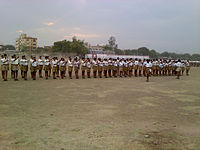
Sangh shakha at Nagpur headquarter
"Shakha" is Hindi for "branch". Most of the organisational work of the RSS is done through the coordination of shakhas or branches. These shakhas are run for one hour in public places. In 2004, more than 60,000 shakhas were run throughout India.[63] The number of Shakas had fallen by over 10,000 since the fall of the Bharatiya Janata Party (BJP) led government in 2004.[64] However, the number of Shakas has again increased to about 40,000 by mid 2014 after the return of BJP to power in Delhi in the same year.[65]
The shakhas conduct various activities for its volunteers which include physical fitness activities through yoga, exercises and games. It has other activities which emphasize on qualities like civic sense, social service, community living and patriotism.[66] The volunteers are trained in first aid and in rescue and rehabilitation operations. The volunteers are also encouraged to get involved in the developmental activities of the village or locality.[66][67]

Mission

The mission of Rashtriya Swayamsevak Sangh has been described as the revitalisation of Indian value system based on universalism and peace and prosperity to all.[59] Vasudhaiva Kutumbakam, the worldview that the whole world is one family, propounded by the ancient thinkers of India, is considered as the ultimate mission of the organisation.[68]
But the immediate focus, the leaders believe, is on the Hindu renaissance, which would build an egalitarian society and a strong India that could propound this philosophy. Hence, the focus is on social reform, economic upliftment of the downtrodden and the protection of cultural diversity of the natives in India.[68] The organisation says, it aspires to unite all Hindus and build a strong India, which could contribute to the welfare of the world. In the words of RSS ideologue and the second head of the RSS, Golwalkar, "in order to be able to contribute our unique knowledge to mankind, in order to be able to live and strive for the unity and welfare of the world, we stand before the world as a self-confident, resurgent and mighty nation".[59]
In Vichardhara (en. Bunch of Thoughts) [Golwalkar affirms the RSS mission of integration as:[59]
RSS has been making determined efforts to inculcate in our people the burning devotion for Bharat and its national ethos; kindle in them the spirit of dedication and sterling qualities and character; rouse social consciousness, mutual good-will, love and cooperation among them all; to make them realise that casts, creeds and languages are secondary and that service to the nation is the supreme end and to mold their behaviour accordingly; instill in them a sense of true humility and discipline and train their bodies to be strong and robust so as to shoulder any social responsibility; and thus to create all-round Anushasana in all walks of life and build together all our people into a unified harmonious national whole, extending from Himalayas to Kanyakumari.
Golwalkar also explains that RSS does not intend to compete in electioneering politics or share power. The movement considers Hindus as inclusive of Sikhs, Jains, Buddhists, tribals, untouchables, Veerashaivism, Arya Samaj, Ramakrishna Mission, etc. as a community, a view similar to inclusive referencing of the term Hindu in the Indian Constitution.[69][70][71]
When it came to non-Hindu religions, Golwalkar's (who once supported Hitler's creation of a supreme race by suppression of minorities)[72] view on minorities was that of extreme intolerance. In a magazine article in 1998 some RSS, and its political offshoot BJP's members have been said to have distanced itself from M.S Golwalkar's views though not entirely.[73]
The non-Hindu people of Hindustan must either adopt Hindu culture and languages, must learn and respect and hold in reverence the Hindu religion, must entertain no idea but of those of glorification of the Hindu race and culture...in a word they must cease to be foreigners; Or may stay in the country, wholly subordinated to the Hindu nation, claiming nothing, deserving no privileges, far less any preferential treatment— not even citizens' rights

Affiliated organizations

Further information: Sangh Parivar
Organisations which are inspired by the Rashtriya Swayamsevak Sangh's ideology refer themselves as the members of the Sangh Parivar.[61] In most of the cases, pracharaks (full-time volunteers of the RSS) were deputed to start-up and manage these organisations in their initial years.
The affiliated organisations include:[75]
Rashtriya Sevika Samiti (English: National Women Volunteers Committee), formed in 1936 Akhil Bharatiya Vidyarthi Parishad (English: All Indian Student Council), formed in 1948 Vanavasi Kalyan Ashram (English: Forest Dwellers Welfare Hermitage), formed in 1952 Bharatiya Mazdoor Sangh (Indian Workers' Union), formed in 1955 Vishwa Hindu Parishad (English: World Hindu Council), formed in 1964 Vidya Bharati (English: Education India - All India Education Organization), formed in 1977 Seva Bharati (English: Service India), formed in 1979 Vanbandhu Parishad (English: Friends of Tribals Society), formed in 1989
Besides above organizations, many other Hindu organisations take inspiration from RSS's philosophy.
RSS has never directly contested elections, but supports parties that are ideologically similar. Although RSS generally endorses the Bharatiya Janata Party (BJP), yet at times had refused to do so due to difference of opinion with the party. Also, RSS is open to support any political party that subscribes to its views.[76][77]
Of late, the volunteers of the RSS have also held prominent political and administrative positions in India including the Prime Minister of India, the Vice President of India, the Home Minister and Ministers in the Central Government, Governors and Chief Ministers of various states and the members of elected bodies at the state and the national level and also the Indian ambassador to the US[78][79][80]

Social service and reform

The RSS has advocated the training of Dalits and other backward classes as temple high priests (a position traditionally reserved for Caste Brahmins and denied to lower castes). They argue that the social divisiveness of the Caste system is responsible for the lack of adherence to Hindu values and traditions and reaching out to the lower castes in this manner will be a remedy to the problem.[81] The RSS has also condemned "upper-caste" Hindus for preventing Dalits from worshipping at temples, saying that "even God will desert the temple in which Dalits cannot enter".[82]
Christophe Jaffrelot finds that "there is insufficient data available to carry out a statistical analysis of social origins of the early RSS leaders" but goes on to conclude, based on some known profiles that most of the RSS founders and its leading organisers, with exceptions were Maharashtrian Brahmins from middle or lower class[83] and argues that the pervasiveness of the Brahminical ethic in the organisation was probably the main reason why it failed to attract support from the low castes. He argues that the "RSS resorted to instrumentalist techniques of ethno-religious mobilisation—in which its Brahminism was diluted—to overcome this handicap".[84] However Anderson and Damle (1987) find that members of all castes have been welcomed into the organisation and are treated as equals.[1]
During M. K. Gandhi's visit to RSS Camp accompanied by Mahadev Desai and Mirabehn at Wardha in 1934, he was surprised by the discipline and the absence of untouchability in RSS and commented "When I visited the RSS Camp, I was very much surprised by your discipline and absence of untouchablity." He personally inquired to Swayamsevaks and found that they were living and eating together in the camp without bothering to know their castes.[85]
Bhimrao Ambedkar while visiting the RSS camp at Pune in 1939 observed that Swayamsevaks were moving in absolute equality and brotherhood without even caring to know the caste of others.[86] In his address to the Swayamsevaks, he said, "This is the first time that I am visiting the camp of Sangh volunteers. I am happy to find absolute equality between Savarniyas (Upper cast) and Harijans (Lower cast) without any one being aware of such difference existing." When he asked Hedgewar whether there were any untouchables in the camp, he replied that there are neither "touchables" nor "untouchables" but only Hindus.[87]
It is noted that RSS provides education to people of rural India and socially backward classes living under the poverty.[88]
In 2009, RSS claimed that western brands like Pepsi and Coca-Cola were corrupting Indian culture, and introduced the cow urine soda Gau jal. The drink contained cow urine with flavors such as aloe vera and some Ayurvedic herbs. The organization believes that the "cow urine is known to treat up to 80 different incurable diseases, including diabetes".[89]

Relief and rehabilitation

The RSS was instrumental in relief efforts after the 1971 Orissa Cyclone, 1977 Andhra Pradesh Cyclone[90] and in the 1984 Bhopal disaster.[91][92] It assisted in relief efforts during the 2001 Gujarat earthquake, and helped rebuild villages.[90][93] Approximately 35,000 RSS members in uniform were engaged in the relief efforts,[94] and many of their critics acknowledged their role.[95] An RSS-affiliated NGO, Seva Bharati, conducted relief operations in the aftermath of the 2004 Indian Ocean earthquake. Activities included building shelters for the victims, providing food, clothes and medical necessities.[96] The RSS assisted relief efforts during the 2004 Sumatra-Andaman earthquake and the subsequent tsunami.[97] Seva Bharati also adopted 57 children (38 Muslims and 19 Hindus) from militancy affected areas of Jammu and Kashmir to provide them education at least up to Higher Secondary level.[98][99] They have also taken care of victims of the Kargil War of 1999.[100]
In 2006, RSS participated in relief efforts to provide basic necessities such as food, milk, and potable water to the people of Surat, Gujarat who were affected by massive floods in the region.[101][non-primary source needed] The RSS volunteers carried out relief and rehabilitation work after the floods ravaged North Karnataka and some districts of the state of Andhra Pradesh.[102] In 2013, following the Uttarakhand floods, RSS volunteers were involved in flood-relief works through its offices set up at various affected areas.[103][104]

Court Rulings on RSS

The State of Madhya Pradesh Vs Ramshanker Raghuvanshi

Many cases have been reported in post-independence India where RSS volunteers have been discriminated against by the government due to their allegiance to the RSS.[105] In a court case of a teacher who was dismissed from service due to his past links with the RSS, the Supreme Court called the government's action as "McCarthyism" and a "violation of fundamental rights". [106][107][108]
A municipal school teacher, Ramshanker Raghuvanshi, was dismissed by the Congress government of Madhya Pradesh in 1974, which stated that he had taken "part in the RSS" activities and thus may have been "not a fit person to be entertained in Government service". The Supreme Court dismissed the arguments of the government and stated that the government had not adhered to the provisions of the Indian Constitution. The Supreme Court bench consisting of Justice Syed Murtuza Fazalali and Justice O. Chinnappa Reddy observed that "India is not a police state" and pleaded that the "promise of fundamental rights enshrined in the Indian Constitution not become a forgotten chapter of history". Delivering the landmark judgment, the Court claimed that it believes "seeking a police report on person's political faith", in the first place, "amounted to the violation of fundamental rights". The Supreme Court ruled in favor of the municipal teacher and ordered his reinstatement.[106][107][108]

State of Karnataka v. Ranganathacharya Agnihotri

Similar decisions were made by the High courts of different states of India in different cases of political persecution of RSS volunteers.[105] One case involved Ranganathacharya Agnihotri, who was selected for the post of Munsiff but was not absorbed into service at least partially because he had been a volunteer of the RSS in his past. When Agnihotri approached to the then High Court of Mysore (now Karnataka High Court), he was reinstated. The Court put forth:
Prima facie the RSS is a non-political cultural organization without any hatred or ill will towards non-Hindus and that many eminent and respected persons in the country have not hesitated to preside over the functions or appreciate the work of its volunteers. In a country like ours which has accepted the democratic way of life (as ensured by the Constitution), it would not be within reason to accept the proposition that mere membership of such peaceful or non-violent association and participation in activities thereof, will render a person (in whose character and antecedents there are no other defects) unsuitable to be appointed to the post of a Munsiff.

Others

The RSS also has been banned in India thrice, during periods in which the government of the time posed that they were a threat to the state: in 1948 after Mahatma Gandhi's assassination, during the Emergency (1975–77), and after the 1992 Babri Masjid demolition. The bans were subsequently lifted, in 1949 after the RSS was absolved of charges in the Gandhi murder case, in 1977 as a result of the Emergency being revoked, and in 1993 when no evidence of any unlawful activities was found against it by the tribunal constituted under the Unlawful Activities (Prevention) Act. [109]

Reception

Field Marshal Cariappa in his speech to RSS volunteers said "RSS is my heart's work. My dear young men, don't be disturbed by uncharitable comments of interested persons. Look ahead! Go ahead! The country is standing in need of your services"[110]
Zakir Hussain, former President of India told Milad Mehfil in Monghyar on 20 November 1949, "The allegations against RSS of violence and hatred against Muslims are wholly false. Muslims should learn the lesson of mutual love, cooperation and organization from RSS.[111][112]
Gandhian leader and the leader of Sarvoday movement, Jayaprakash Narayan, who earlier was a vocal opponent of RSS had the following to say about it in 1977 "RSS is a revolutionary organisation. No other organisation in the country comes anywhere near it. It alone has the capacity to transform society, end casteism and wipe the tears from the eyes of the poor." He further added "I have great expectations from this revolutionary organisation which has taken up the challenge of creating a new India."[55]

Criticisms and accusations

Christophe Jaffrelot, Director of the Center for Studies and Research (CERI), observes that although the RSS with its paramilitary style of functioning and its emphasis on discipline has sometimes been seen by some as "an Indian version of fascism",[113] he argues that RSS's ideology treats society as an organism with a secular spirit, which is implanted not so much in the race as in a socio-cultural system and which will be regenerated over the course of time by patient work at the grassroots. He writes that ideology of the RSS did not develop a theory of the state and the race, a crucial elements in European nationalisms; Nazism and Fascism"[113] and that the RSS leaders were interested in cultural as opposed to racial sameness.[114]
The likening of the Sangh Parivar to "fascism" by Western critics has also been countered by Jyotirmaya Sharma who labelled it as an "attempt by them to depress indian patriotism and unity". And that such "simplistic transference" has done great injustice to our knowledge of Hindu nationalist politics.[115]
In response to a high-profile gang rape in Delhi, Mohan Bhagwat, the head of RSS, stated that such incidents only happen in cities, not villages. He further blamed "western values" for the increase in rapes in India. Women's groups have countered that statistics show that rapes in rural India often go unreported.[116] Bhagwat's remarks created a controversy and were criticised by activists and other political parties.[117]

Involvement with riots

The RSS has been censured for its involvement in communal riots.
After giving careful and serious consideration to all the materials that are on record,the Commission is of the view that the RSS with its extensive organisation in jamshedpur and which had close links with the Bharatiya Janata Party and the Bharatiya Mazdoor Sangh had a positive hand in creating a climate which was most propitious for the outbreak of communal disturbances.
In the first instance, the speech of Shri Deoras (delivered just five days before the Ram Navami festival) tended to encourage the Hindu extremists to be unyielding in their demands regarding Road No. 14. Secondly, his speech amounted to communal propaganda. Thirdly, the shakhas and the camps that were held during the divisional conference presented a militant atmosphere to the Hindu public. In the circumstances, the commission cannot but hold the RSS responsible for creating a climate for the disturbances that took place on the 11th of April, 1979
— Jitendra Narayan in a report on Jamshedpur riots of 1979[118][119]
Human Rights Watch, a non-governmental organisation for human rights based in New York, has claimed that the Vishwa Hindu Parishad (World Hindu Council, VHP), the Bajrang Dal, the Rashtriya Swayamsevak Sangh and the BJP have been party to the Gujarat violence that erupted after 56 Hindus were burnt alive in a coach of Sabarmati Express train at Godhra station by a Muslim mob.[120] Local VHP, BJP and BD leaders have been named in many police reports filed by eyewitnesses.[121] RSS and VHP claimed that they made appeals to put an end to the violence and to have asked their supporters and volunteer staff to prevent any activity that might disrupt peace.[122]

Religious violence in Odisha

Christian groups accuse the RSS alongside its close affiliates, the Vishwa Hindu Parishad (VHP), the Bajrang Dal (BD) and the Hindu Jagaran Sammukhya (HJS) of participation in the 2008 Religious violence in Odisha.[123]
A US-based Christian charity working in Orissa claimed that Hindu extremists persuaded mobs to kill Christians and destroy their homes.[123] RSS disputed the allegations, calling them "absolutely false" and blamed the Indian National Congress for the violence.[123][124] The violence was triggered by the murder of a senior VHP member Swami Lakshamananda Saraswati.[125] The police have arrested Pradesh Kumar Das, an employee of the World Vision, a Christian Charity, from Khadagpur while escaping from the district at Buguda. In another drive, two other persons Vikram Digal and William Digal have been arrested from the house of Lal Digal, a local militant Christian, from Nuasahi at Gunjibadi, Nuagaan. They have admitted to having joined a group of 28 other assailants.[126] RSS/HJS blamed Mr. Radha Kanta Nayak, a member of Congress party of being responsible for the killing and accused a non-governmental organisation supported by him, World Vision, of being involved in religious conversions.[124]

Involvement in Babri Masjid demolition

According to the report of the Liberhan Commission the Sangh Parivar organised the destruction of the Babri Masjid.[11][127] The Commission said- "The blame or the credit for the entire temple construction movement at Ayodhya must necessarily be attributed to the Sangh Parivar".[128] It also noted that the Sangh Parivar is an "extensive and widespread organic body", which encompasses organizations, which address and bring together just about every type of social, professional and other demographic grouping of individuals.
Each time, a new demographic group has emerged, the Sangh Parivar has hived off some of its RSS inner-core leadership to harness that group and bring it within the fold, enhancing the voter base of the Parivar.[129]
The RSS has denied reliability and questioned the objectivity of the report. Former RSS chief K. S. Sudarshan posed allegations that the mosque was demolished by the government men as opposed to the Karsevaks. The RSS alleges that the commission reports are fabricated and motivated primarily by anti-Indian sentiment than any objective desire to seek justice."[130]
On the other hand, a government of India white paper dismissed the idea that the demolition was pre-organised.[131]